Salmon Pants
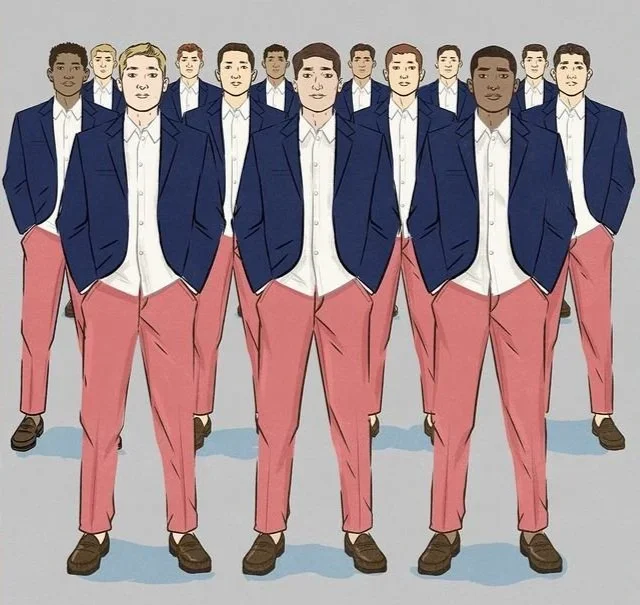
Source: Wall Street Journal (Paul Tuller)
Salmon-colored pants and long-sleeved Vineyard Vines shirts - often with a large embroidered whale or yacht across the back - were my uniform back then. I completed the look with a Patriots snapback and the long, swept-back "flow" hairstyle that was popular at the time. Like many teenagers, I even left the round sizing sticker on the brim of my caps because everyone else did. My mother, however, thought it looked ridiculous and peeled them off without a second thought.
I grew up in a place where sailing and lacrosse were almost nonexistent. For years, I thought Cape Cod was simply the name of a potato chip brand because it was always packed in my lunch for away games. Many of my classmates, on the other hand, spent their summers sailing or fishing there and casually tossed lacrosse balls back and forth as if they had grown up with sticks in their hands. I wanted to fit in, but I quickly realized that belonging required more than speaking English. There was an entire world of shared experiences, references, and assumptions that I simply did not have.
It felt like a collision between two worlds. I wanted the comfort that came with being included, but I believed that meant leaving parts of myself behind. I copied the slang my classmates used and even practiced what I thought sounded like a New England accent. No one asked me to do these things. I did them because I desperately wanted to become one of the "cool kids" - someone others naturally wanted to spend time with. Before moving to the United States, I had assumed that once I became fluent in English, everything else would fall into place. Instead, I discovered that language was only one layer. I often missed subtle humor, gestures, and social cues, and conversations slipped away before I understood why.
Language itself is an imperfect tool. I once read an author who compared it to washing dishes: we try to achieve something spotless with imperfect hands and imperfect tools. Communication depends as much on eye contact, tone, rhythm, and shared context as it does on vocabulary. Growing up in a relatively homogeneous community, I rarely thought about these things. People around me spoke similarly, and small misunderstandings were easy to smooth over. Walking into a room where I was visibly different forced me to confront something I had never considered before: how I was perceived by others. For the first time, I realized that communication was about far more than literal words. Feeling lost, I did what seemed safest - I mimicked the way my friends dressed, talked, and carried themselves.
It worked, at least from a distance. I pretended to know the Bruins' score from the night before and repeated jokes that had earned laughs at another lunch table without fully understanding why they were funny. I was invited to hang out, yet I often felt like a substitute player standing at the edge of a team huddle - close enough to see inside but never fully part of it. The friendships were real, but many of the interests were not my own. For a long time, I measured my worth by how well I could earn approval from others, until I gradually lost sight of who I was without that approval.
That search continued into college. Surrounded by even more people in New York City, I no longer knew whose expectations I was trying to meet. There were simply too many groups, too many identities, and too many ways to belong. Eventually, I stopped trying to keep up with all of them. I began visiting museums alone, watching football games at bars without pretending to know more than I did, and taking long walks through parks with nowhere particular to be. None of these activities had a purpose beyond enjoying my own company. Slowly, I rediscovered hobbies I had neglected for years. They felt unfamiliar at first, almost like meeting an old friend after a long absence, but they also felt unmistakably mine.
Over the past decade, I have met people from every corner of the world. Along the way, I have embarrassed myself more times than I can count while trying to navigate unfamiliar cultures and communities. Looking back, those awkward moments matter far less than I once believed. They became part of the foundation that allows me to step into new environments with curiosity instead of fear.
I still wear salmon-colored pants today. Some people see them as preppy and tacky; others think they are stylish. Either way, they remind me of a younger version of myself who was trying so hard to belong. Now, they remind me of something different - not how far I still have to go, but how far I have already come.