A River Runs Through It
Before I came to the U.S., I saw a film that left me with a certain picture of the country: dense forests, clear rivers, and a fly line moving back and forth overhead, with that soft sound as it cut through the air. I imagined that America would have places like that. Years later, I went to high school near Great Barrington, where the Housatonic River winds through the landscape. Probably because it was so close, I hardly went. The landscape I had once imagined from afar had become part of the background of ordinary life.
I recall that one of my teachers loved fly fishing, and through him the film came back to me. Its final scene had stayed with me all those years. I liked it enough that I used its closing monologue in place of my own comment in the yearbook. At that age, I think I was mostly taken by the beauty of it - the casting, the river, the idea of standing alone in moving water. Only much later, standing in a river myself, did I begin to understand what else might have drawn me to it. The soft sound of a fly line cutting through the air can only be heard when the world around it is quiet enough. Perhaps what stayed with me was not simply the fishing, but a world quiet enough to hear it.
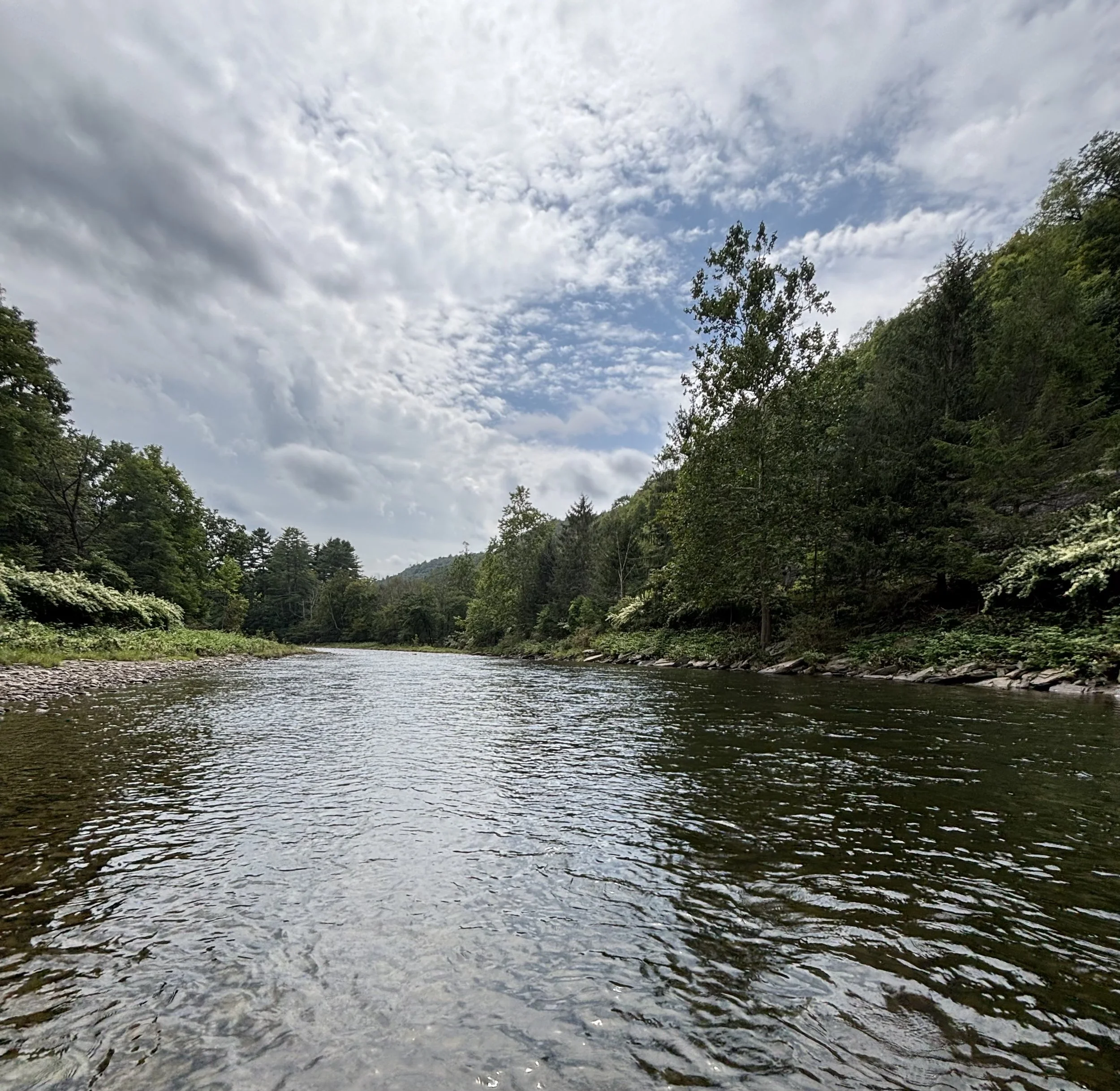
I spent close to four hours standing in the Willowemoc River, casting. After a while, I began to notice the temperature of the water and the force of it pressing against my legs. From the bank, the river had looked almost frighteningly clear and still. Once I was in it, I realized how deceptive that stillness was. The water was always moving, always pushing against me. I did not catch a single trout. By the end of August, I was told, they were tired from a long season of feeding, hiding, and surviving. They had spent the warmer months avoiding hooks and birds, among other things. At first, I was impatient. I had traveled for hours and set aside the time; surely I ought to catch at least one. But after casting, letting the fly drift, pulling it back, and casting again, catching one slowly stopped mattering. I caught nothing, yet the hours did not feel wasted.
My guide was around my age. He had taken up fly fishing in high school and never really left it. After enough time fishing, he told me, you realize that you no longer come for the trout. You come for the river. Not long ago, he had come across a few foxes by the water and found himself watching them, almost spellbound, forgetting about the fishing for a while. The foxes probably did not help his chances. There was something special about that. The man and the foxes had both come to the river looking for trout, yet for a moment the man forgot the trout and watched the foxes instead. Before a river, perhaps, we become something more alike: creatures drawn to the water, looking for something, staying for a while, and then leaving.
People have been fishing these waters for nearly two hundred years. I wondered how many had stood where I stood. Some must have arrived impatient, as I did, and some must have gone home without catching a thing. Others may have found the river when they were young and kept returning for the rest of their lives. People were not the only ones. There were trout, birds, foxes, each coming to the same water for reasons of their own. And for the fishermen, all that effort often ends in a peculiar gesture: after spending hours trying to catch a trout, you place it gently back into the water. You work so hard to hold something in your hands only to let it go. Maybe catching a fish is not quite the reason we go to the river. It could simply be the reason we give ourselves to enter it.
The water was so clear that I could see the rocks beneath my feet, but I could not know what lay beneath them. I could not know who had stood there over those centuries, what they had thought about, whom they had missed, or what they had gained or lost before stepping back onto the bank. Still, it seemed to me that something must remain. Beneath water that never stops moving are the traces of everyone who has come to it - their hours, their memories, perhaps even something of what brought them there. For a little while, I had stood among them, listening to the line cut softly through the air and feeling the cold current against my legs. Then I stepped back onto the bank. The river kept moving, carrying with it a little more time than before.